
 EN
EN
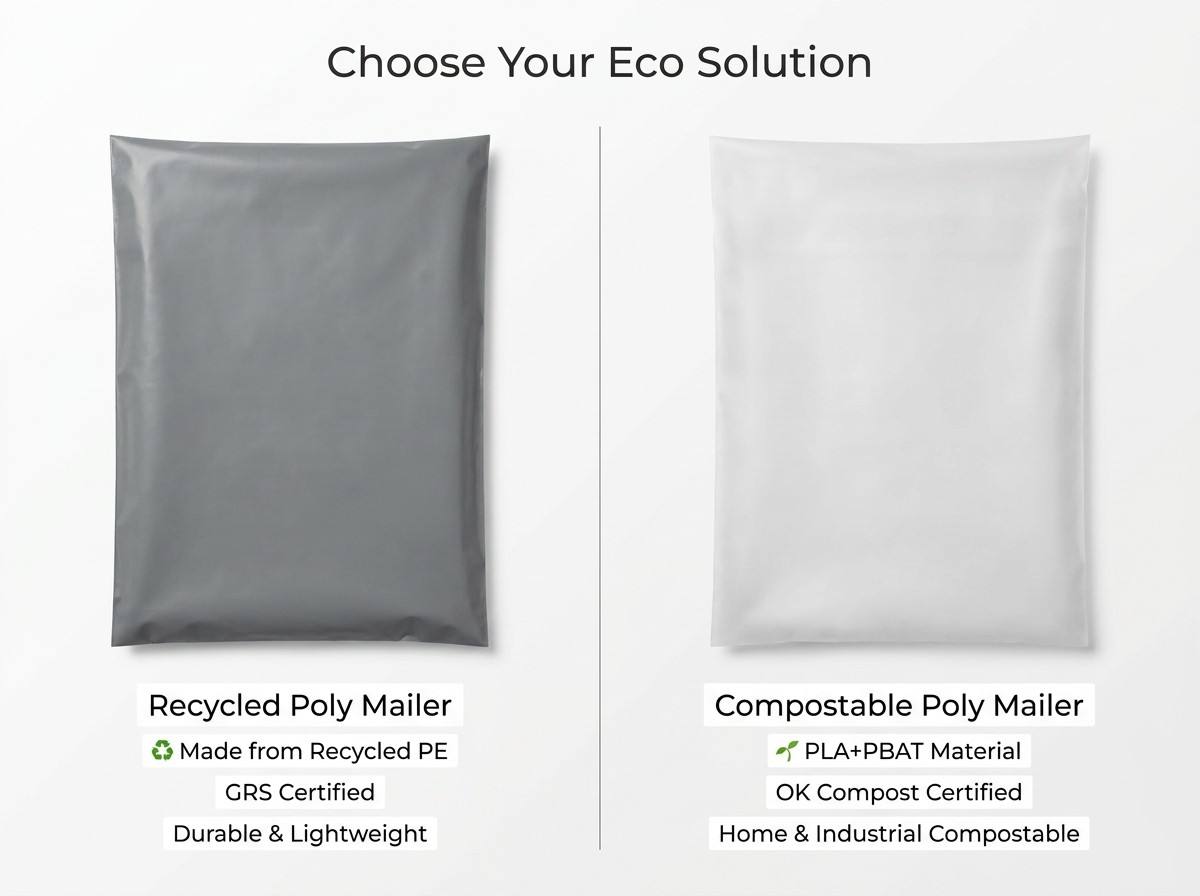
Recycled poly mailers reuse existing plastic waste and stay in the recycling stream. Compostable poly mailers are made from plant-based PLA+PBAT and break down into organic matter under composting conditions. The right choice depends on your brand values, customer habits, and local waste infrastructure — and this guide will help you decide.
What Are Recycled Poly Mailers?
Recycled poly mailers are made from Post-Consumer Recycled (PCR) or Post-Industrial Recycled (PIR) LDPE — giving existing plastic a second life instead of sending it to landfill.
Material: Recycled LDPE | Certifications: GRS (Global Recycled Standard)
Pros :
- Same tear resistance and moisture protection as virgin plastic
- Unlimited shelf life — no degradation in storage
- Generally more cost-effective than compostable options
- Strong "recycled content" marketing claim
Cons :
- End-of-life still depends on local soft plastic recycling infrastructure
- Visually still "plastic" — lower eco-perception vs. compostable
Best for : High-volume e-commerce sellers who want to reduce virgin plastic without a premium price increase.
What Are Compostable Poly Mailers?
Compostable poly mailers are engineered from PLA (Polylactic Acid) derived from corn starch, blended with PBAT for flexibility and strength. They break down into water, CO₂, and biomass under composting conditions — leaving no microplastics.
Material: PLA + PBAT bio-resin | Certifications: TÜV OK Compost (Industrial & Home), EN 13432, ASTM D6400
Pros :
- No toxic residue — genuinely returns to nature in composting conditions
- Premium silky matte texture — signals eco-commitment to customers
- No microplastics, unlike oxo-degradable alternatives
Cons :
- Shorter shelf life — best used within 10–12 months, store in cool dry conditions
- Higher unit cost than recycled or standard mailers
Best for : Eco-forward brands, organic retailers, DTC brands whose customers actively compost.
Head-to-Head Comparison
Which Option Is Right for Your Brand?
High-volume e-commerce seller : Recycled mailers let you market "Made from 100% Recycled Plastic" without a significant cost premium. Practical and scalable.
Sustainable fashion / boutique brand : If "plastic-free" is core to your story, compostable is non-negotiable. The tactile difference tells customers you mean it.
Supermarket / retail chain : Many regions are mandating compostable carrier bags. Compostable mailers also double as organic waste bin liners — functional added value.
Budget-conscious startup : Recycled mailers are the lowest-barrier entry into sustainable packaging — strong credentials, approachable cost.
Why Richer EcoPack for Both Options
At Richer EcoPack (Xiamen) Co., Ltd., we manufacture both recycled and compostable mailers in our own factory:
- Custom printing — up to 8 colors, eco-friendly inks
- Any size — standard or fully custom dimensions
- Full certifications — documentation available for GRS, TÜV OK Compost
- Factory-direct pricing — no middleman, competitive wholesale rates
Explore our Poly Mailers product page or check our Poly Mailer Sizes Guide to choose the right dimensions before ordering.
FAQ
Q: Are compostable mailers as strong as regular plastic?
Yes. PLA+PBAT blends are specifically engineered for e-commerce transit — excellent tensile strength and moisture resistance.
Q: Can I print my logo on both types?
Yes. Richer EcoPack offers custom printing on both recycled and compostable mailers using eco-friendly inks.
Q: How should I store compostable poly mailers?
Store in a cool, dry place away from direct sunlight and humidity. Avoid high temperatures which can trigger early degradation.
Q: What is the shelf life of recycled poly mailers?
Recycled LDPE mailers have virtually unlimited shelf life — they do not degrade over time under normal storage conditions.
Q: Which is better for the environment — recycled or compostable?
Neither is universally "better." Recycled supports the circular economy; compostable supports the biological cycle. The right choice is whichever your customers can actually dispose of correctly.